Web 2.0 gets a lot of hype, but if anyone really gets it, it is Jonathan Coulton. Jonathan Coulton, if you have never heard of him is a singer songwriter from New York City. He writes genial, usually humorous tunes. Some I like are Ikea, Re: Your Brains, The Presidents, and, of course, every geek's favorite, Code Monkey. He achieved a level of internet fame a few years ago for his "thing a week" podcast wherein he composed, produced, and published a new song each week for a year. For this he was profiled in the New York Times Sunday Magazine. At around the same time he did the Pop Sci podcast, an interview program for Popular Science Magazine, and worked with John Hodgman on the Little Grey Book Lectures.
What makes Coulton distinctive though is his relationship to his fan base and use of the internet to maintain this. During the "thing a week" period people started sending him videos, graphics, and other artifacts relating to his songs, which he would dutifully post. This established a positive feedback loop between him and his fans. A number of these home made videos became minor hits on youtube, increasing his audience.
As far as I know, Coulton does not have an agent, a manager, a record label, air play, or any other accouterments of popular music success. His albums are not on Amazon. His songs are not protected by DRM. But, then there he is, making a living and supporting his family. He does have an occasional backup band and he occasionally backs up John Hodgman's bookstore appearances.
Coulton regularly posts concert announcements to his blog, but will also post a little wrapup afterwards, almost a thank you note. The audience is always described as awesome, as I am sure they are. Recently, Coulton has been having his audience pose for a photograph from the stage at concerts and posting them on his blog. I think this is genius. It completes the web 2.0 loop: seamlessly merging the world of real life with the world of the web. At a concert in Chicago not long ago he invited the star of a popular Youtube video for Code Monkey come on stage to reproduce the video live. This, of course, was immediately posted to Youtube.
What really strikes me about the Jonathan Coulton approach to the internet is its old fashioned civility. Trust, thank you notes, and pictures of the event to help everyone remember. If I was running a music company I would be quaking in my boots.
- J
Showing posts with label work. Show all posts
Showing posts with label work. Show all posts
Sunday, December 9, 2007


Good Bye, Berkeley! So long, paths not taken.

K had her the last session of her Berkeley class yesterday. I, as usual accompanied her. As usual I walked in the hills seeking out the pedestrian paths common there. There is a nice map published by the Berkeley Path Wanderers, but I am lazy, so I just wander into likely cul de sacs. I quite like wandering the paths. It short circuits in sometimes interesting ways the distinction among neighborhoods. Arriving on a street from a walking path feels like entering a restaurant from the kitchen side. Mostly the paths are unadorned but once I passed a bulletin board with xeroxed poetry tacked to it.
Yesterday I started out in the Elmwood district and soon found myself on a trail the Claremont Canyon Regional Park behind the old School for the Deaf (now Clark Kerr UC campus). This was not exactly an urban path, but it suited. It was cold and clear and the views of the Golden Gate were spectacular.
I got to thinking that my walks were not just about locating physical paths, but also an attempt to locate some of the paths not taken in my life. I think I felt this could help me with my current quandry with work. If I could only resurrect meaning and neglected possibility from long ago, perhaps I could trace it forward. It seems to me that most of those paths originated in Berkeley, or were abandoned in Berkeley when K and I followed my jobs to the South Bay.
It was good, remembering. Of course the idea of being able to take up those old paths was foolish. K and I have occasionally talked of moving back to Berkeley, and maybe we will some day, but we will not find the Berkeley we knew. Those paths are washed away. The answer to the conundrum lies in the future, not the past.
- J
Monday, November 26, 2007
Painting the Shed
I painted the garden shed over the weekend. I began at about nine and finished at almost four. No breaks. I meant to stop when I was hungry or tired but I did not get hungry or tired. In recent years my appetite has been on a reliable schedule, so I was surprised.
Some time ago I wrote about the psychological concept of flow, a state of mind where time seems to disappear and where the person experiences a sustained period of concentration.
This was not "flow", but it was something like it. The thing is: I don't particularly like painting. I don't mind it, but its not an activity I would choose for its own sake. I do not find it absorbing. It has a momentum, though. You can see progress and you can see the end point. And there is a cost to taking a break: you have to clean your brushes.
A few years ago we had to have a sewer line replaced. This took a week and the workers would work into the evening. Sometimes we would have to go out and tell them to stop for fear that they would disturb the neighborhood. When talking to the workers I would be surprised to learn that they had not stopped all day, not even for a meal. They would have worked through the night, too. This was dirty, backbreaking physical work, not the kind that the inventors of the concept of "flow" had in mind, but indeed they clearly had lost track of time.
I think gamblers feel the same thing, and this is not quite "flow" either. Pulling the arm of a slot machine they clearly sometimes feel, "just one more pull and I will stop."
-- J
Some time ago I wrote about the psychological concept of flow, a state of mind where time seems to disappear and where the person experiences a sustained period of concentration.
This was not "flow", but it was something like it. The thing is: I don't particularly like painting. I don't mind it, but its not an activity I would choose for its own sake. I do not find it absorbing. It has a momentum, though. You can see progress and you can see the end point. And there is a cost to taking a break: you have to clean your brushes.
A few years ago we had to have a sewer line replaced. This took a week and the workers would work into the evening. Sometimes we would have to go out and tell them to stop for fear that they would disturb the neighborhood. When talking to the workers I would be surprised to learn that they had not stopped all day, not even for a meal. They would have worked through the night, too. This was dirty, backbreaking physical work, not the kind that the inventors of the concept of "flow" had in mind, but indeed they clearly had lost track of time.
I think gamblers feel the same thing, and this is not quite "flow" either. Pulling the arm of a slot machine they clearly sometimes feel, "just one more pull and I will stop."
-- J
Saturday, November 17, 2007
On being the Under Gardener

In our garden I am the under gardener. Kris found this term used in a now defunct gardening blog, Knit A Garden (thank you way back machine!) It gave us laugh in self recognition. It has always been my role. We never spoke about it. It just came out that way. I prepare beds. K plants them. I rake, hoe, and weed. K waters and harvests. K knows the names and habits of all the species and varieties that dwell in our 1/3rd acre. Anything requiring knowledge, expertise, and creativity is in her purview, anything that gets one's knees dirty is in mine. (This is not completely fair; K is not afraid of work in the garden, its just the brainwork is her exclusive domain.)
This is not at all a bad deal for me. On a weekend day I love having the sun on my back and dirt under my fingernails. After a week of manipulating symbols on a screen it is nice to be able to do real work and see concrete changes in a patch of ground. I enjoy that my part is simple, brutish, and repetitive.
This is a part of the polity of marriage or at least of our marriage. There has to be a way to make decisions. Everything cannot be done by common consent. Even when things are by common consent, in any given sphere one will have more interest or knowledge and tend to prevail. For us in the garden it is K.
We have visited gardens of friends or seen gardens on garden tours and have seen evidence of other political strategies at work. We have seen several yards where half the garden (usually the front) "belongs to" the wife and the other half the husband. Sometimes there is even a fence dividing them and a sign at the gate between. Sometimes the rule appears to be that the husband operates the machinery and the wife the hand tools. Sometimes the husband does the hardscape and the wife the plant life. Gardening couples that share equally in the decision making are pretty rare, at least in these parts.
- J
(Illustration is "Royal Gardener John Rose and King Charles II" by Hendrick Danckerts and is in the public domain. I found it on wiki commons.)
Wednesday, November 7, 2007
Modern again...
A month later, our dishwasher is fixed. We are no longer heathens. No one here is sure how they will like the cold efficiency of the twenty first century.
- J
- J
Saturday, November 3, 2007
Burn-out advice
I came across this article on dealing with job burn-out from a referral on Lifehacker. Its best advice was to make a list of things you like about your job and try to arrange to do more of that.
It got me thinking about workplace advice from literature:
It got me thinking about workplace advice from literature:
- King Lear, Shakespeare: It's not really a good idea to delegate your major responsibility to others and try to keep the perks. A worse yet idea to delegate to sycophants. It puts the world out of balance.
- The Tempest, Shakespeare: Sometimes getting fired from your job can have its benefits. It can give you the opportunity to perfect your skills. Once that is done, you may find yourself running the place again. Also, do not neglect to cultivate friends in high and low places.
- Old Man and the Sea, Hemingway: If you accomplish a big thing. Look out for sharks.
- Bartleby the Scrivener, Melville: Even if you are burned out, it's possible to hang on for quite some time.
- A Tuft of Flowers, Frost: Mainly it is people that give work meaning.
Monday, October 15, 2007
"Men at the Gates"
Apropos of yesterday's post came this poem, "Men at the Gates" by Gary L Lark. Its about men waiting for a closed factory to open, men who see themselves as builders and cannot adjust to how the world now sees them. I am not sure how much of a poem comprises fair use, so I will only quote its ending:
They wait for the world
to make sense again,
where calluses grow on your hands
and the soreness in your back
means you're worth a damn.
Read the whole thing.
- J
Sunday, October 14, 2007
Boosters and Builders

I think I have thought of the world of work as being populated by boosters and builders. Boosters sell, cajole, convince, promote, and coerce. Builders turn raw materials, whether physical commodities or data, into things of use. Boosters accomplish things by manipulating human emotions and social relationships. Builders do not encumber their human relationships with self-interest and are therefore are able to interact with others more honestly and freely. Sales and marketing departments are filled with boosters. Engineering, manufacturing, and accounting departments are filled with builders.
Obviously, in this, I favor the builders. Authenticity is on the side of builders. Artifice on the side of boosters. (Yes, I too noticed that artifice, as a word, relates to building.) Builders deal with solid things, boosters with spun threads of cotton candy. Engineering managers, usually coming from a technical background, inevitably turn more and more into boosters as they move up the corporate ladder. I think of this as their route to the dark side.
I realize this is a simplistic model, but it, I think it has informed a good many of the big and small choices I have made with respect to work, especially in recent years. Several times I have turned down management roles. I try to avoid meetings that involve marketing people. I have become more iconoclastic.
In my present company (and, in all likelihood, in many tech companies of a similar age) the divide between the boosters and builders is particularly well defined. The boosters, the marketing and sales types as well as the executive staff and most managers are freshfaced and white. They jog on their lunch hour. They talk about golf. The technical and accounting staff are almost always Asian and with young families.
I think, in part, that my view of the work world and my poor attitude towards big parts of it have led some social skills and sensitivities I may have once possessed to atrophy. I see marketing and sales types like they are spiders traversing with ease strands that are invisible to me. This may be the basis for the mistrust I feel. I do not understand how they move, why they do what they do, where they will go next. I become anxious among them.
I am not sure where these remarks lead. I have been living with this model of the work world for some time. It has become an unhealthy and self-limiting way to regard the world. In the abstract I can see its flaws. Yet, at this time, I am not entirely ready to throw it over. We shall see.
- J
(Image of bee hive is from wiki commons and is in the public domain.)
Tuesday, October 9, 2007
On Washing Dishes

Our dishwasher is has been on the fritz. Our lives have been pretty complicated lately, so when it broke I suggested that we not deal with it right away. Here's the thing, though. Since the dishwasher broke, our kitchen has been noticeably cleaner. Counters are tidier. Dishes are put away faster. I am not sure why.
I will admit that I enjoy hand washing dishes. If I am alone it is a nice quiet meditative activity. If I am washing them with another the activity has a good pace that is conducive to conversation. Yet, I used the dishwasher the same as everyone else, when it was working.
Part of the reason things are cleaner, I think, is because of the threat of disorder. Things have no where to go and can get out of hand pretty quickly. A few weeks ago there was built in slack. Sure things could get bad, but you can just gather the dishes and cutlery and shove it in the coated wire slots and you are done. The knowledge that you could do that lessens the necessity of doing it.
Another aspect is personal velocity. If you have an expectation that a task will need a minute then you are going to rush the task and you won't have time for distractions and annoyances you might encounter. If you expect to be spending twenty or so minutes in the kitchen and you spot a spice bottle out of place its not a bother to set it right.
I am sure we will eventually repair the dishwasher and resume our proper relation to domestic work. We are after all modern people. We are not heathens.
-- J
(Image is of a painting by Jean-Baptist Simeon Chardin. I found it here. It is in the public domain.)
Wednesday, October 3, 2007
Change
Just a quote for the day to mull over:
And change is a semi with smoking wheels filling the rear view mirror.
Tuesday, October 2, 2007
Surf
Many years ago I worked for a big Asian electronics company in their Silicon Valley plant. A fellow, I don't recall his name, so we'll call him Jim, had the cube next to mine. He was a shortish balding guy with an active smile. He was devoted to bluegrass. He was an old line assembly language programmer, and I suppose I was the young blood. At that time the embedded software world was moving from assembly language on raw iron to C programs written with the benefit of real-time operating systems.
Every now and again I would look over at him staring at his screen or (the were still in use then, a printout.) I could see in his eyes no comprehension. It was just a field of random characters for him. I could not tell whether he was trying to make sense of it or whether his mind was elsewhere and he was just waiting for it to end.
Jim did not have to wait very long. He was layed off within a couple of months of my arrival. I never saw him again. My boss, when I asked, said he had been suspected of sneeking off to a closet during the workday for a drink. I did not and do not believe it.
After that I have seen the same blank look on compatriots and the same ambigous affect. There have been times when an observer would have seen the same look in me. I came to think of the software business as like swimming in the surf. If you hold yourself steady you can keep your head above water and at times command a good clear view. But inevitably you will tire and your attention will wander for a spell and you will find yourself tumbling in wild surf. It is difficult to resist the pull downward.
I have been underwater a number of times. I thought my career was dead. So far, I have arighted myself, usually by change of circumstances.
- J
Every now and again I would look over at him staring at his screen or (the were still in use then, a printout.) I could see in his eyes no comprehension. It was just a field of random characters for him. I could not tell whether he was trying to make sense of it or whether his mind was elsewhere and he was just waiting for it to end.
Jim did not have to wait very long. He was layed off within a couple of months of my arrival. I never saw him again. My boss, when I asked, said he had been suspected of sneeking off to a closet during the workday for a drink. I did not and do not believe it.
After that I have seen the same blank look on compatriots and the same ambigous affect. There have been times when an observer would have seen the same look in me. I came to think of the software business as like swimming in the surf. If you hold yourself steady you can keep your head above water and at times command a good clear view. But inevitably you will tire and your attention will wander for a spell and you will find yourself tumbling in wild surf. It is difficult to resist the pull downward.
I have been underwater a number of times. I thought my career was dead. So far, I have arighted myself, usually by change of circumstances.
- J
Friday, September 28, 2007
A Tuft of Flowers
I have been thinking about this poem:
I think this is a good deal of what gives work meaning; shared purpose and shared values. I think this is a lot of what has been missing from my work. My company was gobbled up by a larger company this year and my new company is a wholly owned subsidiary of a multinational corporation of very dubious reputation. The new company is based elsewhere and they appear to have a paternalistic patronizing attitude towards employees. We know them, so far, mostly through the policies that come down or the marketing campaigns that are tried out on employees first. I have always worked mostly alone, staring at a screen all day, but I have not always felt alone.A Tuft of Flowers
Robert Frost - A Boy's Will (1913)
I went to turn the grass once after one
Who mowed it in the dew before the sun.
The dew was gone that made his blade so keen
Before I came to view the leveled scene.
I looked for him behind an isle of trees;
I listened for his whetstone on the breeze.
But he had gone his way, the grass all mown,
And I must be, as he had been,—alone,
‘As all must be,’ I said within my heart,
‘Whether they work together or apart.’
But as I said it, swift there passed me by
On noiseless wing a ’wildered butterfly,
Seeking with memories grown dim o’er night
Some resting flower of yesterday’s delight.
And once I marked his flight go round and round,
As where some flower lay withering on the ground.
And then he flew as far as eye could see,
And then on tremulous wing came back to me.
I thought of questions that have no reply,
And would have turned to toss the grass to dry;
But he turned first, and led my eye to look
At a tall tuft of flowers beside a brook,
A leaping tongue of bloom the scythe had spared
Beside a reedy brook the scythe had bared.
I left my place to know them by their name,
Finding them butterfly weed when I came.
The mower in the dew had loved them thus,
By leaving them to flourish, not for us,
Nor yet to draw one thought of ours to him.
But from sheer morning gladness at the brim.
The butterfly and I had lit upon,
Nevertheless, a message from the dawn,
That made me hear the wakening birds around,
And hear his long scythe whispering to the ground,
And feel a spirit kindred to my own;
So that henceforth I worked no more alone;
But glad with him, I worked as with his aid,
And weary, sought at noon with him the shade;
And dreaming, as it were, held brotherly speech
With one whose thought I had not hoped to reach.
‘Men work together,’ I told him from the heart,
‘Whether they work together or apart.’
On the other hand, seen from the perspective of the mower: some nut disturbing my lunch with crazy talk about flowers and butterflies. What was he smoking?
- J
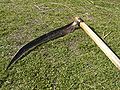
(The poem is in the public domain. The scythe image is by Chmee2, is in the public domain, and was found here.

Wednesday, September 19, 2007
Flow

I listened to "This American Life" today. David Rakoff had a wonderful piece on the psychological concept of "flow". This is an idea articulated by Mihaly Csikszentmihalyi that describes a human state of concentration where time falls away. David Rakoff, it turns out loves doing crafts as an avocation because he can lose himself in the flow experience. So, he visits the craft department at Martha Stuart's Living, the center of all things crafts. The people who work there recognize the state of concentration he describes, but, it turns out, it is a bit harder to achieve when it is scheduled; when it is work.
I was trying to remember the last time I felt that sense of flow in my work. Certainly I have felt it, though, only irregularly, at best. The thing is that the work of programming, all the mythology of the software field, is all built around flow. Deep in the mythology of every important programming language, operating system, or paradigm shifting applications are stories of working programs emerging from the smallest seed of an idea after a night of concentrated coding. These are programs that changed not only my profession, but defined our time.
It is impossible for me to imagine myself so lost in concentration on some software problem that I would lose track of time, that the lines would pour out from my fingers, beautiful and perfect. It happened only rarely before. It will never happen again. Am I too old? Is it this damned repetitive stress pain? Is it because of the corrupting influence of the paycheck?
Alternatively, does it need to flow? Does it have to be a zen experience? Can it be hard, slow, and painful and still mean something? Does it mean more as work that it is written as if a spirit has a hold of your keyboard or does it mean more that you can predict the weather from the pain in your joints?
(Image, by Abangmanuk, is a canghul, an Indonesian hoe. It is from wikicommons. Image is in the public domain.)

-- J
Monday, September 17, 2007
A Beginning
Here is a beginning.
This is a blog about life, love, and work, in no particular order. It seeks no particular audience.
The title of the blog is taken from a lively song of the same name by Greg Brown., about the frustrations of hoeing. The song is honest about backbreaking farm work. It romanticizes it not a bit. It treats it with humor, yes, but it is a gallows humor.
Having stolen the title, though, it is obvious that I don't have the same scruples. I am going to shamelessly romanticize hoeing. Hoeing, you see, is not just backbreaking, futile, and repetitive work, it is a metaphor! Hoeing is tending and caring for living things. Hoeing is slow and incremental work from which things of beauty and value are nurtured and born. Hoeing is after all a synonym for cultivating, and cultivating is a root for culture.
I am hoping that this blog to be a form of hoeing (probably in its more romantic formulation). By tending my row in small daily increments I hope to grow something of worth to a few people.
- J
Been walking the beans
Been walking the beans
Been bending low, down low,
Been ripping my jeans
Been walking the beans
In the burning sun
And it looks like I ain't ever ever gonna get done.
-- Greg Brown, "Walking the Beans" from the album Iowa Waltz
This is a blog about life, love, and work, in no particular order. It seeks no particular audience.
The title of the blog is taken from a lively song of the same name by Greg Brown., about the frustrations of hoeing. The song is honest about backbreaking farm work. It romanticizes it not a bit. It treats it with humor, yes, but it is a gallows humor.
Having stolen the title, though, it is obvious that I don't have the same scruples. I am going to shamelessly romanticize hoeing. Hoeing, you see, is not just backbreaking, futile, and repetitive work, it is a metaphor! Hoeing is tending and caring for living things. Hoeing is slow and incremental work from which things of beauty and value are nurtured and born. Hoeing is after all a synonym for cultivating, and cultivating is a root for culture.
I am hoping that this blog to be a form of hoeing (probably in its more romantic formulation). By tending my row in small daily increments I hope to grow something of worth to a few people.
- J
Subscribe to:
Posts (Atom)